
Facelift & Zygoma Reduction: The Hidden Relationship Between Two Major Facial Contouring Surgeries

How bone movement and soft‑tissue repositioning interact — and why the order of these surgeries matters more than most people realize.
In Korea’s highly advanced aesthetic surgery landscape, two procedures stand out as transformative pillars of facial rejuvenation and contouring: facelift surgery and zygomatic reduction surgery. One lifts and tightens the soft tissues of the face; the other reshapes the skeletal architecture that defines mid‑facial width.

At first glance, these procedures seem to belong to different worlds — one focused on aging, the other on bone structure. But in reality, they are deeply connected. Their relationship is anatomical, aesthetic, and surgical. And understanding how they interact is essential for anyone considering either procedure, especially foreigners seeking treatment in Korea’s globally renowned plastic surgery centers.
This feature explores the hidden interplay between facelift and zygoma reduction, revealing why surgeons often evaluate them together, how one procedure can influence the results of the other, and why the sequence of these surgeries can dramatically affect long‑term outcomes.
⭐ The Midface: The Anatomical Intersection of Both Surgeries
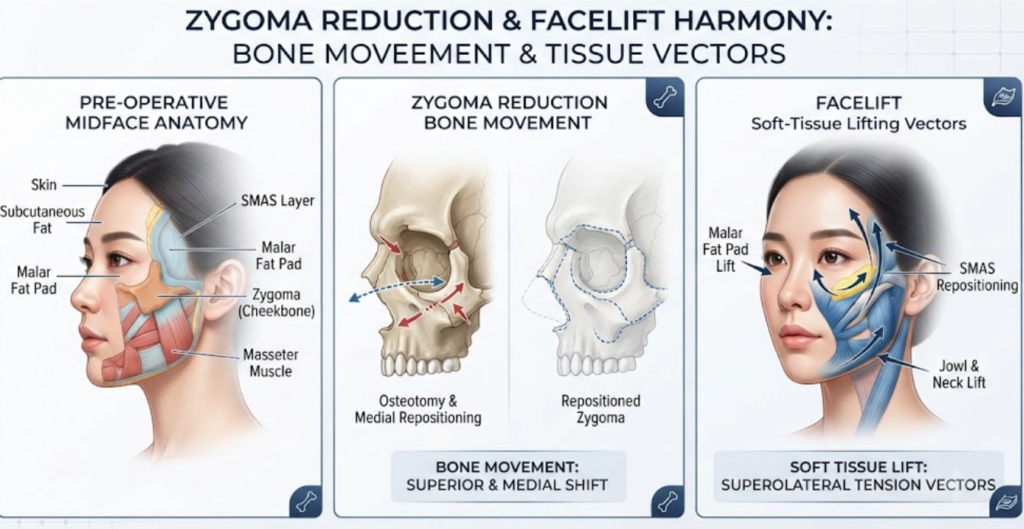
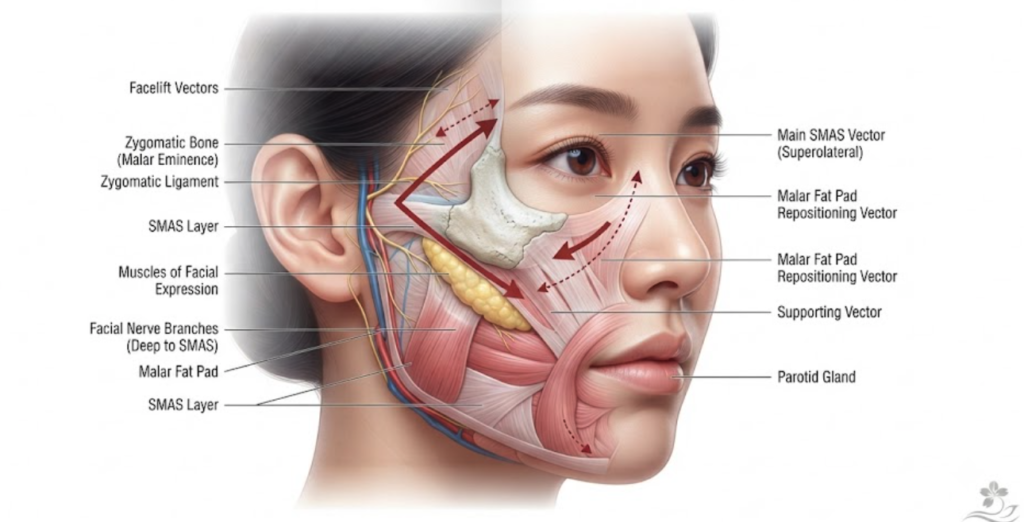
Both facelift and zygoma reduction target the midface, the central region that includes the cheekbones, the malar fat pad, the SMAS layer, and the nasolabial fold.
A facelift elevates and tightens the soft tissues of this region.
Zygoma reduction reshapes the bone beneath those tissues.
This shared territory is the foundation of their relationship.
When the bone moves, the soft tissue responds.
When the soft tissue is lifted, the underlying bone structure determines the final contour.
In other words:
You cannot change one without influencing the other.
⭐ How Zygoma Reduction Changes Mid‑Facial Volume
Zygoma reduction surgery (commonly known as “cheekbone reduction”) involves cutting and repositioning the zygomatic bone inward. This reduces facial width and creates a slimmer, more refined contour.
But this inward movement also causes:
- Reduced mid‑facial projection
- Loss of lateral cheek volume
- Soft‑tissue redundancy (extra skin and SMAS that no longer drape tightly)
- Potential hollowing beneath the cheekbone
- Increased visibility of nasolabial folds
These changes are not flaws — they are natural consequences of bone repositioning.
However, they directly influence how the face ages and how the soft tissues behave afterward.
This is where facelift surgery enters the conversation.
⭐ Why Facelift Becomes More Relevant After Zygoma Reduction
When the cheekbone moves inward, the soft tissues that once stretched over a wider structure suddenly have less support. This can lead to:
- Mild sagging in the midface
- Deepened nasolabial folds
- A subtle “deflated” look
- Downward migration of the malar fat pad
- Early jowling in some patients
Facelift surgery — especially SMAS facelift — can correct these issues by:
- Re‑suspending the mid‑facial soft tissues
- Restoring cheek volume through repositioning
- Tightening redundant skin
- Improving nasolabial folds
- Enhancing jawline definition
This is why many Korean surgeons describe facelift as a “soft‑tissue harmonizer” after bone contouring procedures.
⭐ The Aesthetic Relationship: Structure vs. Soft Tissue
Think of the face as a building:
- The bone is the frame.
- The soft tissue is the exterior finish.
Zygoma reduction changes the frame.
Facelift adjusts the exterior.
When the frame becomes narrower, the exterior may need tightening or repositioning to match the new structure.
This is why patients who undergo cheekbone reduction often notice that their face looks slimmer but also slightly looser — a phenomenon that facelift can elegantly correct.
⭐ Why the Order of Surgeries Matters
✔ Recommended Order: Zygoma Reduction → Facelift
This is the sequence preferred by most Korean surgeons.
Why?
Because:
⭐ Why the Order of Surgeries Matters
✔ Recommended Order: Zygoma Reduction → Facelift
This is the sequence preferred by most Korean surgeons.
Why?
Because:
- Bone repositioning changes the soft‑tissue drape.
- Facelift can then refine and tighten the new contours.
- The surgeon can lift the SMAS in a direction that complements the new cheekbone position.
- The final result looks more natural and cohesive.
✔ Reverse Order: Facelift → Zygoma Reduction
This is not ideal.
If a facelift is performed first:
- The SMAS is tightened.
- The skin is repositioned.
- The soft tissues are lifted into a new configuration.
But when zygoma reduction is performed afterward:
- The bone moves inward.
- The tightened soft tissues lose support.
- The facelift results may partially loosen.
- The patient may require a second facelift.
This is why the sequence is critical.
⭐ Can Both Surgeries Be Done Together?
Yes — and in Korea, this combination is increasingly popular.
Advantages of simultaneous surgery:
- One recovery period
- Perfect alignment of bone and soft‑tissue vectors
- More natural mid‑face contour
- Reduced risk of post‑zygomatic sagging
- Better long‑term stability
Disadvantages:
- Longer surgery time
- Higher cost
- More swelling during recovery
Still, for many patients, the combined approach produces the most harmonious results.
⭐ Soft‑Tissue Redundancy: The Key Concept Linking Both Procedures
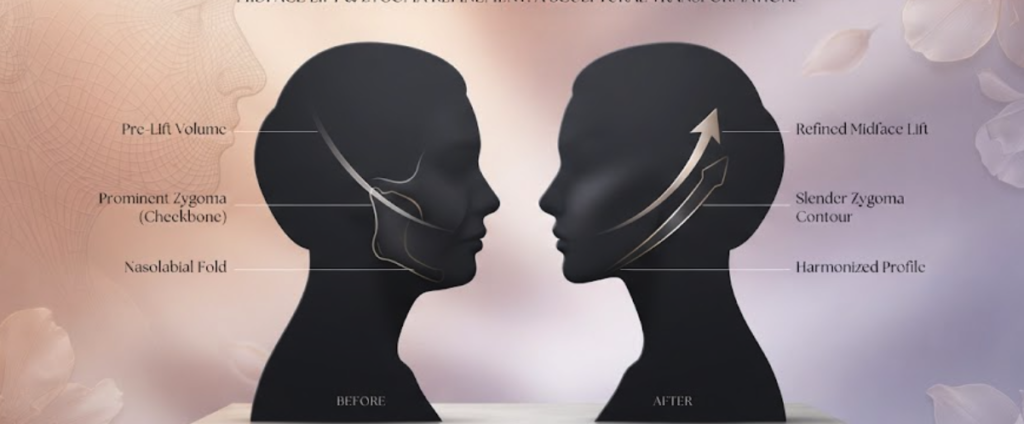
After zygoma reduction, the soft tissues may not shrink to match the new bone width.
This creates what surgeons call soft‑tissue redundancy — extra skin and SMAS that can sag or fold.
Facelift directly addresses this by:
- Tightening the SMAS
- Repositioning the malar fat pad
- Smoothing the nasolabial fold
- Sharpening the jawline
- Restoring youthful tension
This is the most important anatomical link between the two surgeries.
- Tightening the SMAS
- Repositioning the malar fat pad
- Smoothing the nasolabial fold
- Sharpening the jawline
- Restoring youthful tension
This is the most important anatomical link between the two surgeries.
⭐ Why Foreign Patients Should Understand This Relationship
Foreigners often come to Korea for:
- V‑line surgery
- Zygoma reduction
- Anti‑aging procedures
- Facelift surgery
But many do not realize that bone contouring can accelerate or reveal soft‑tissue aging.
Understanding the relationship between these surgeries helps patients:
- Plan long‑term aesthetic goals
- Avoid unexpected sagging
- Choose the right sequence
- Achieve more natural results
- Reduce the need for revision surgery
Korea’s top clinics emphasize this connection during consultation — and it’s one of the reasons Korean facial contouring results are globally admired.
⭐ Expert Insight: Why Surgeons Evaluate Both Procedures Together
Korean plastic surgeons often say:
“Bone defines the shape. Soft tissue defines the expression.”
This means:
- Zygoma reduction creates the structural foundation.
- Facelift refines the expression and surface aesthetics.
When evaluated together, the surgeon can design a holistic facial plan that considers:
- Bone width
- Mid‑face volume
- SMAS tension
- Skin elasticity
- Aging patterns
- Desired facial proportions
This integrated approach is a hallmark of Korean aesthetic surgery.
⭐ Recovery Considerations When Combining Both Procedures
Patients who undergo both surgeries — either sequentially or simultaneously — should expect:
- Longer swelling period
- Temporary tightness in the midface
- Gradual improvement over 3–6 months
- More dramatic final results
- Better long‑term stability
Korean clinics typically provide:
- Lymphatic drainage therapy
- Ultrasound healing sessions
- Scar management programs
- Detailed follow‑up schedules
These enhance recovery and optimize results.
⭐ Conclusion: Aesthetic Harmony Requires Both Structure and Lift
Facelift and zygoma reduction are not isolated procedures.
They are two sides of the same aesthetic coin — one reshaping the skeletal foundation, the other refining the soft‑tissue envelope.
Their relationship is:
- Anatomical
- Functional
- Aesthetic
- Surgical
- Sequential
Understanding this connection empowers patients to make smarter decisions, achieve more natural results, and avoid common pitfalls.
For anyone considering facial contouring or anti‑aging surgery in Korea, recognizing how these two procedures interact is essential.
In the hands of Korea’s top surgeons, the combination of facelift and zygoma reduction can create a balanced, youthful, and beautifully sculpted face — one that ages gracefully and maintains harmony between bone and soft tissue.

🔗 Official Clinic Resources
For readers who want deeper insight into facelift, zygoma reduction, and advanced facial contouring techniques, you can explore detailed surgical explanations, before‑and‑after cases, and surgeon interviews through the official channels of Kidari Plastic Surgery Clinic, one of Korea’s well‑known facial contouring centers.
✔ Kidari Plastic Surgery Clinic — Official Website
https://beanpoleps.com/inc/index.php
✔ Kidari Plastic Surgery Clinic — Official YouTube Channel
https://youtube.com/channel/UC8n-YGd3wJaahGeESfi8ldA?si=8UNy5AIAm-TXfCWR