

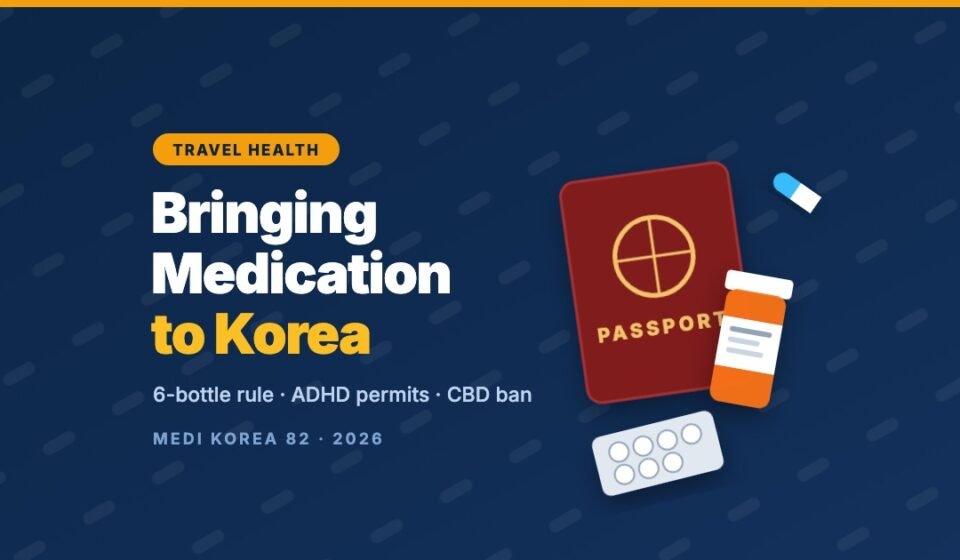
Bringing Medication to Korea (2026): Prescription Drugs, ADHD Meds and Customs Rules

“Can I bring my medicine to Korea?” is one of the questions I see most often from people planning a trip or a move here. The answers online are scattered across embassy notices, old forum threads and news articles, and some of them are out of date. So I went through the official notices from Korea’s Ministry of Food and Drug Safety (MFDS) and Korean embassies, plus the rule change announced in November 2026, and put everything in one place.
The short version: most everyday and prescription medicines are fine in reasonable amounts, but anything classed as a narcotic or psychotropic drug, including many ADHD medications, needs a permit before you fly.
Can I Bring Medicine to Korea? The Quick Answer
- Ordinary prescription medicine: yes. Under the rules MFDS announced on November 11, 2026, you can bring up to six bottles of a medicine that is approved in your country and was bought with a doctor’s prescription. If you need more, you can bring up to a three-month supply at your prescribed dose.
- Single-use injections such as Mounjaro or Wegovy: up to 12 doses, with your prescription.
- ADHD stimulants, strong painkillers and other controlled drugs: only with an MFDS permit, applied for at least 10 business days before you arrive.
- Cannabis and CBD products: no, even with a prescription.
- Mailing medicine to yourself in Korea: avoid it. Controlled medicines sent by post are seized.
Ordinary Prescription Medicines: The Six-Bottle Rule
Until recently, travelers could get into trouble at customs even with a prescription in their own name, because officers checked bags against a list of flagged ingredients. That changed in November 2026. After talking with the Korea Customs Service, MFDS clarified that people may bring in prescription medicines for their own treatment as long as the drug is officially approved by the regulator in the country where it was prescribed.
The limit is six bottles. If your treatment needs more than that, you can bring up to three months’ worth based on the dose on your prescription. For once-a-week injections like Mounjaro, the cap is 12 doses. The rule applies to foreign tourists, international students and Koreans returning home alike.
What I would pack with it: the prescription itself or a doctor’s note in English, and the medicine in its original box or pharmacy bottle with your name on the label. That way you can show at a glance that it is yours and for personal use.
Over-the-Counter Medicine: Cold Pills, Allergy Tablets and Painkillers
I couldn’t find an official notice that spells out a separate number for over-the-counter medicine, so I treat it the same way as prescriptions: a personal amount, in the original packaging. A box of allergy tablets, some ibuprofen and your usual cold medicine are what most travelers carry without any problem.
The one thing worth checking is the ingredient list. Some cough syrups and cold medicines sold abroad contain codeine, which Korea treats as a narcotic. If yours does, either leave it at home or apply for a permit as described below. If you run out after you arrive, Korean pharmacies sell most basics. What to ask for at the counter: Korean Pharmacy Guide for Foreigners
ADHD Medication and Other Controlled Drugs Need an MFDS Permit
This is the part that catches people out. Since 2009, anyone entering Korea with medicine that contains a narcotic or psychotropic substance needs a permit from the MFDS Narcotics Policy Division, whatever their nationality. That usually covers ADHD stimulants, strong opioid painkillers and many sleeping pills and anti-anxiety drugs. A prescription alone is not enough.
How to Apply
MFDS has taken applications online since December 27, 2024, through its drug information portal (nedrug.mfds.go.kr). Older embassy notices also list the email address narcotics@korea.kr. Because of the 10-business-day processing time, I would apply at least two to three weeks before your flight. The documents MFDS asks for are:
- The application form for incoming travelers (Form 1 and Form 2 in the embassy notices)
- A copy of your passport
- Your flight booking, showing entry and departure dates and flight numbers
- A doctor’s letter or medical certificate with your diagnosis, the drug’s brand and generic names, dose and quantity, signed and dated
- A valid prescription with the generic name, dose and quantity
Documents need to be in English or Korean. If yours are in another language, a notarized translation is required.
How Much You Can Bring
The permit covers up to 90 days at the maximum dose your doctor prescribed, plus up to five days extra. If you are staying longer than three months, the medicine for the rest of your stay has to be prescribed by a doctor in Korea. The permit is only for the patient, so you cannot apply on behalf of a family member or friend, and you have to carry the medicine yourself in your hand luggage.
If you need a doctor here for a refill, this step-by-step guide covers clinics, costs and what to bring: How to See a Doctor in Korea as a Foreigner
Cannabis and CBD Are Banned
Korea does not allow cannabis in any form, and the ban explicitly includes products containing CBD or THC, such as oils, gummies and creams. A prescription from home does not change this, so leave anything CBD-related at home.
My Packing Checklist for Medicine
- Keep every medicine in your carry-on, not your checked bag.
- Leave pills in the original box or labeled pharmacy bottle.
- Bring the prescription or a doctor’s note in English.
- Check ingredients for codeine or other controlled substances.
- For ADHD or other controlled drugs, apply to MFDS at least 10 business days ahead and print the permit.
- Pack only what you need for your stay, and no more than six bottles or a three-month supply.
If you are coming to Korea for treatment, these are the other documents worth bringing: Korean Medical Tourism Travel Checklist
FAQ: Bringing Medicine Into Korea
Do I need to declare my medicine at customs?
I couldn’t find a rule that asks you to declare ordinary medicine within the limits above. If you are carrying a lot, or you are not sure whether something is allowed, the simplest thing is to declare it and let the customs officer check it.
Can someone send my medicine to me by post?
For controlled medicines, no. Medicines containing controlled substances should not be mailed into Korea, and customs destroys them or returns them to the sender.
Can I bring medicine for my child or partner?
I would keep each person’s medicine with their own prescription and their own name on the label. For controlled drugs this is a hard rule: each permit is issued only to the person taking the medicine.
Where can I check the latest rules?
The rules changed as recently as November 2026, so I would confirm with the MFDS Narcotics Policy Division (+82-43-719-2813) or the Korean embassy in your country before you fly.
Sources: Ministry of Food and Drug Safety; Korean Ministry of Foreign Affairs embassy notice (July 2024); Royal Danish Embassy in Seoul; Korea JoongAng Daily, November 11, 2026. Last checked November 2026.
Related Posts


Discover more from Medi Korea 82
Subscribe to get the latest posts sent to your email.


