


Korea is one of the most popular places in Asia for laser eye surgery. Seoul has many large eye clinics that do hundreds of LASIK, LASEK and SMILE procedures a week, and prices are often much lower than in the United States, Australia or Singapore. That is why “LASIK in Korea price” is one of the most common questions foreigners search before booking a trip.
This guide explains how much LASIK, LASEK, SMILE and SMILE Pro cost in Korea in 2026, how they differ, how long you need to stay, and how to book as a foreigner. Last updated: November 2026.
Quick Answer
- LASIK in Korea: commonly about US$975 to $1,650 (₩1,300,000 to ₩2,200,000) for both eyes.
- SMILE in Korea: commonly about US$1,500 to $2,600 (₩2,000,000 to ₩3,500,000) for both eyes.
- SMILE Pro: the newest version, commonly about US$1,875 to $3,000 (₩2,500,000 to ₩4,000,000) for both eyes.
- How long to stay: plan about 5 to 7 days in Korea for LASIK or SMILE, and 1 to 2 weeks for LASEK.
- Insurance: vision correction is not covered by Korea’s National Health Insurance, so everyone pays out of pocket.
How Much Is LASIK in Korea? (2026 Prices)
The ranges below are based on prices published by Korean eye clinics and Korean medical booking platforms in 2026. Korean clinics usually quote prices for both eyes, which is one reason they look so low next to prices abroad.
Prices below are shown in US dollars at the November 2026 exchange rate (₩1,000 ≈ US$0.75), with Korean won alongside.
| Procedure | Approx. price in USD (both eyes) | In Korean won | Typical recovery |
|---|---|---|---|
| LASEK / PRK | $900 – $1,500 | ₩1,200,000 – ₩2,000,000 | 3–5 days of discomfort, clear vision in 1–2 weeks |
| LASIK | $975 – $1,650 | ₩1,300,000 – ₩2,200,000 | Clear vision in 1–2 days |
| SMILE (ReLEx SMILE) | $1,500 – $2,600 | ₩2,000,000 – ₩3,500,000 | Clear vision in 1–3 days |
| SMILE Pro | $1,875 – $3,000+ | ₩2,500,000 – ₩4,000,000+ | Clear vision in 1–3 days |
Things that change the final price:
- Per eye or both eyes: a few ads show the price for one eye. Always ask, “Is this for both eyes?”
- Add-ons: custom or wavefront-guided treatment, corneal cross-linking for thinner corneas, and premium eye drops can each add about US$150 to $375 (₩200,000 to ₩500,000).
- Event prices: Korean booking apps often show discounted prices. Check that the same price applies to foreign patients and what is included.
- Foreign patient services: clinics with English, Japanese or Chinese coordinators may charge a little more, but they handle translation, scheduling and paperwork for you.
LASIK in Korea vs the US and Other Countries
In the United States, LASIK is usually quoted per eye, and prices of around US$2,000 to $3,000 per eye are common. That can mean $4,000 or more for both eyes. In Korea, many clinics charge less than that for both eyes, and SMILE is widely available at large clinics.
Even after adding flights and a week in Seoul, some patients from the US, Australia and Singapore still spend less overall. The savings are smaller for people from countries where LASIK is already cheap, so compare a full written quote with prices at home before you decide.
SMILE vs LASIK vs LASEK: Which One Is Right for You?
| LASIK | LASEK | SMILE / SMILE Pro | |
|---|---|---|---|
| How it works | A thin corneal flap is made, then the laser reshapes the cornea | No flap; the surface layer is removed and grows back | A small lens-shaped piece of tissue is removed through a tiny cut, with no flap |
| Recovery | Fast | Slowest, with a few painful days | Fast |
| Dry eye | More common at first | Moderate | Usually less |
| Good for | Most people with normal corneas | Thin corneas, contact sports | Active lifestyles, dry-eye concerns, short trips |
| Price | Mid | Lowest | Highest |
SMILE Pro uses a newer and faster laser (ZEISS VISUMAX 800) than the original SMILE. The basic idea is the same. The main differences are a shorter laser time and the newer equipment, which is why it costs more. Not every eye is suitable for SMILE, especially with high astigmatism, so the clinic will recommend a method after testing your eyes.
For a general introduction to Korean eye clinics, see our Korean eye clinics guide to LASIK and LASEK.
Who Can Get LASIK or SMILE?
You are usually a good candidate if:
- You are at least 18 to 20 years old
- Your prescription has been stable for about a year
- Your corneas are thick and healthy enough
- You do not have certain eye diseases, such as keratoconus or untreated severe dry eye
- You are not pregnant or breastfeeding
Some people find out at the pre-op exam that one method is not suitable for them, and a few are told not to have laser surgery at all. A good clinic will tell you honestly. For very high prescriptions, clinics may suggest lens implants (ICL) instead, which cost much more.
Step by Step: Getting LASIK in Korea as a Foreigner
- Contact clinics before your trip. Many Seoul clinics have English websites, WhatsApp, KakaoTalk or LINE. Send your current prescription and ask for a price range and their pre-op exam schedule.
- Stop wearing contact lenses. Clinics usually ask you to stop soft lenses about 1 week before the exam and hard or toric lenses for 2 to 3 weeks or more, because lenses change the shape of the cornea. Follow your clinic’s rule.
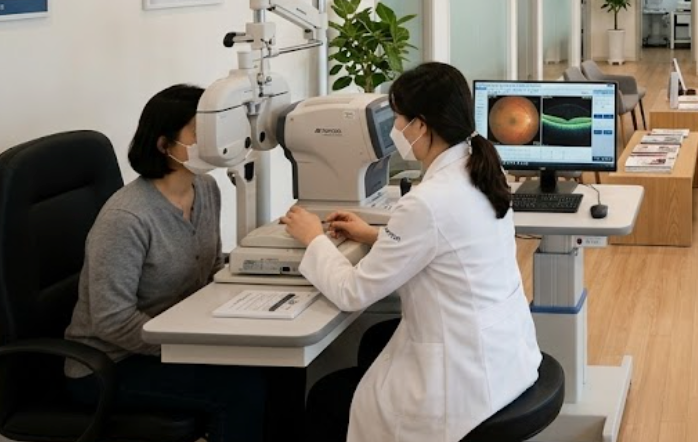
- Pre-op exam (about 2 to 3 hours). Expect 10 or more tests, including corneal thickness and shape, dry eye and a dilated eye check. Bring sunglasses, because your pupils stay dilated for several hours. Many clinics include the exam if you have surgery there.
- Surgery day. The laser part takes only minutes per eye. Plan for 2 to 3 hours at the clinic in total, and do not drive.
- Check-up the next day. Almost every clinic checks your eyes the day after surgery.
- Final check before you fly. Ask for another check before departure and a written summary (in English) of what was done and which eye drops to use.
Bring your passport. You do not need Korean health insurance for this surgery. If you have never visited a Korean clinic before, our guide on how to see a doctor in Korea as a foreigner explains the basics.
How Long Should You Stay in Korea?
| Procedure | Recommended stay | Why |
|---|---|---|
| LASIK | 5–7 days | Exam, surgery, next-day check and a final check before flying |
| SMILE / SMILE Pro | 5–7 days | Same as LASIK; vision is usually clear within a few days |
| LASEK | 1–2 weeks | The surface layer needs several days to heal, and a protective lens is often removed after about 4 to 5 days |
Some clinics can do the exam and surgery on the same day, but it is safer to leave time in case the doctor wants to recheck something. Ask your clinic when it is safe for you to fly. For planning the rest of your trip, see our medical travel checklist for Korea.
📶 Stay connected in Korea
A Korea eSIM lets you message your eye clinic, use maps and translation apps, and call 1330 for interpretation from the moment you land.
Booked via Klook · Affiliate link · Disclosure
LASIK Recovery Time and Aftercare
- First day: watery, scratchy eyes and blurry vision are normal. Rest and keep your eyes closed as much as possible.
- First week: use the prescribed eye drops on schedule, wear the eye shield while sleeping if given one, and do not rub your eyes.
- Avoid for about 1 to 2 weeks: eye makeup, swimming pools, saunas, hot springs and dusty places. Follow your clinic’s exact timeline.
- Dry eye and night glare: halos around lights at night and dry eyes are common for weeks to a few months and usually improve.
Contact the clinic right away if you have strong pain, sudden worse vision, or redness that keeps getting worse.
How to Choose a LASIK Clinic in Korea
- Ask who operates: make sure an ophthalmologist (안과 전문의, angwa jeonmunui) does both the exam review and the surgery.
- Ask which laser they use: for example, VISUMAX 500 or 800 for SMILE.
- Get a written quote that says both eyes and lists the exam, add-ons, eye drops and follow-up visits.
- Ask about follow-up after you go home: some clinics answer questions by email or messenger and can share your records with an eye doctor in your country.
- Be careful with pressure: a clinic that pushes the most expensive option before testing your eyes is a warning sign.
Useful Korean Phrases at the Eye Clinic
| English | Korean | Pronunciation |
|---|---|---|
| I’d like a LASIK consultation. | 라식 상담 받고 싶어요. | rasik sangdam batgo sipeoyo |
| Is this price for both eyes? | 양안 가격이에요? | yangan gagyeogieyo? |
| Is the exam included? | 검사비 포함이에요? | geomsabi pohamieyo? |
| When can I fly? | 언제 비행기 탈 수 있어요? | eonje bihaenggi tal su isseoyo? |
| My eyes hurt. | 눈이 아파요. | nuni apayo |
Frequently Asked Questions
How much is LASIK in Korea?
In 2026, LASIK in Korea commonly costs about US$975 to $1,650 (₩1,300,000 to ₩2,200,000) for both eyes. SMILE usually costs more, about US$1,500 to $2,600 (₩2,000,000 to ₩3,500,000).
Is LASIK in Korea cheaper than in the US?
Usually, yes. US clinics often quote around $2,000 to $3,000 per eye, while many Korean clinics charge less than that for both eyes. Add your travel costs before comparing.
Is SMILE better than LASIK?
Not always. SMILE has no flap and often causes less dry eye, but LASIK can treat a wider range of prescriptions. The best method depends on your eye exam results.
How soon can I fly after LASIK in Korea?
Many patients can fly a few days after LASIK or SMILE once the clinic has checked their eyes. LASEK patients usually need to wait longer. Always ask your doctor first.
Can foreigners get LASIK in Korea without Korean insurance?
Yes. Vision correction is not covered by Korean National Health Insurance for anyone, so tourists and residents pay the same way. You only need your passport.
The Bottom Line
LASIK in Korea is popular with foreigners because large Seoul clinics offer modern lasers, fast scheduling and prices that are often lower than at home. Expect about US$975 to $1,650 (₩1.3 million to ₩2.2 million) for LASIK and US$1,500 to $2,600 (₩2 million to ₩3.5 million) for SMILE for both eyes, stop wearing contact lenses before the exam, and plan about a week in Korea. Get a written quote for both eyes and follow-up care before you book.
This article is for general information only and is not medical advice. Prices are based on published clinic and booking-platform listings in 2026 and may change. Dollar figures use the November 2026 exchange rate (₩1,000 ≈ US$0.75). Your eye doctor will decide which procedure is safe for you.
Related Posts


Discover more from Medi Korea 82
Subscribe to get the latest posts sent to your email.