

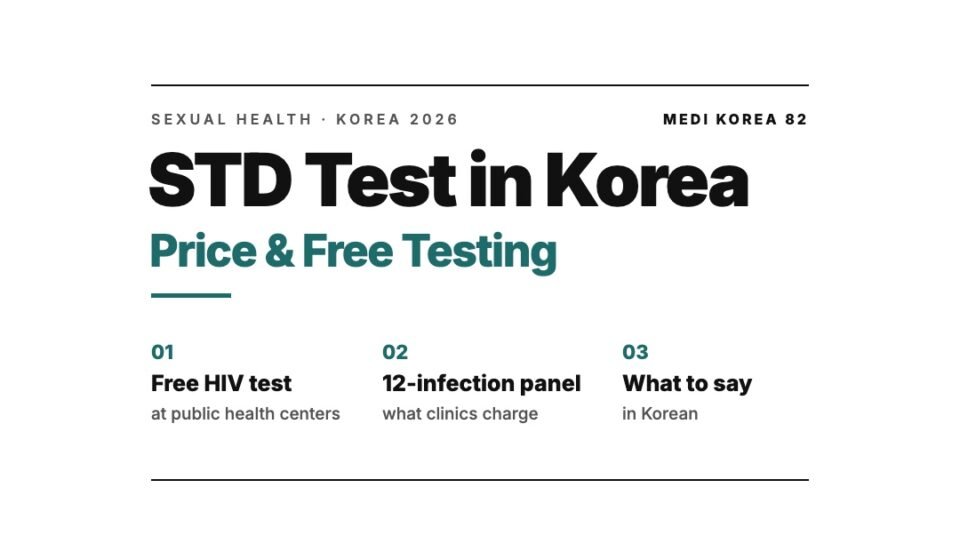

Getting an STD test in Korea is easier and cheaper than many people expect, but the information in English is thin and often years old. I went through notices from several district public health centers and price guides from Korean clinics, and put together what you actually need to know: where to go, what it costs and what to say when you get there.
Quick Answer: STD Testing in Korea
- Free option: public health centers (보건소, bogeonso) offer free, anonymous HIV tests, and many also test for syphilis and other infections for free. What is included depends on the district.
- Clinic option: urology clinics (비뇨의학과) and women’s clinics (산부인과) run full panels, including a 12-infection PCR test from a urine sample or swab.
- Cost at a clinic: roughly US$15–23 (₩20,000–₩30,000) when national health insurance covers it because you have symptoms, and around US$60 (₩80,000) for the same panel as a screening test without insurance.
- Bring ID: some health centers ask foreigners for a residence card, and a passport may not be accepted.
Dollar amounts use the November 2026 exchange rate (₩1,000 ≈ US$0.75). Clinic prices vary.
Free Testing at Public Health Centers (보건소)
Every city district in Korea has a public health center, and this is the place to start if cost or privacy is your main concern. HIV testing is free and can be done anonymously: you write a nickname and a contact number instead of your real name, and you don’t have to show ID. Health centers I checked state that this applies regardless of nationality or where you live.
Other infections are where districts differ. Some centers test for syphilis, gonorrhea and chlamydia for free, while others only offer syphilis and HIV, or don’t allow anonymous testing for anything except HIV. One Seoul district, for example, lists syphilis, gonorrhea and HIV for men and syphilis and HIV for women, and asks foreigners for a residence card rather than a passport. Because of this, I would call your local center before you go.
Two more things are worth knowing. The health center test is a screening test, so a positive result has to be confirmed at a hospital. And for HIV, health centers recommend testing about 12 weeks after a possible exposure, because an early test can come back negative even when there is an infection.
Testing at a Private Clinic
If you want everything checked at once, or you already have symptoms, a private clinic is faster and more complete. Men usually go to a urology clinic (비뇨의학과), and women to a women’s clinic (산부인과). Many clinics list STD testing on their websites, and walk-ins are common, though calling ahead never hurts.
The most common option is the STD 12 panel (STD 12종 검사), a PCR test that looks for 12 infections, such as chlamydia, gonorrhea, trichomonas and mycoplasma, from a urine sample or swab. HIV, syphilis and hepatitis need a separate blood test, so ask for those too if you want a full check.
How Much an STD Test Costs in Korea
Price depends mostly on whether national health insurance covers the test. If you have NHIS and the doctor finds symptoms or a likely infection, the STD 12 panel is usually covered, and Korean clinic guides put your share at roughly US$15–23 (₩20,000–₩30,000). As a screening test without symptoms, the same panel typically costs around US$60 (₩80,000), and overall prices range from about US$23 to US$75 (₩30,000–₩100,000) depending on the clinic and how many tests you add.
Without NHIS you pay the uninsured price either way. A consultation fee is usually added on top, so ask the reception desk for the total before the test if budget matters. If you are not sure whether you are covered, this guide explains who can join national health insurance: National Health Insurance Korea for Foreigners
What to Say at the Clinic or Health Center
A short sentence on your phone is enough: 성병 검사 받고 싶어요 (seongbyeong geomsa batgo sipeoyo), meaning “I would like an STD test.” At a clinic you can add STD 12종 검사 (STD sibijong geomsa) for the 12-infection panel. At a health center, 익명 검사 (ingmyeong geomsa) means anonymous test.
Step by Step
- Decide between a free health center test and a full clinic panel.
- For a health center, call ahead to check which tests they offer, their hours and what ID they need.
- For a clinic, find a nearby urology or women’s clinic in a map app and bring your residence card or passport.
- Give a urine sample, swab or blood sample, depending on the test.
- Get your results by phone, text or a return visit. Clinics often have PCR results within a few days.
If this is your first visit to a Korean clinic, this step-by-step guide explains how it works: How to See a Doctor in Korea as a Foreigner
FAQ: STD Testing in Korea
Is STD testing in Korea anonymous?
HIV tests at public health centers can be fully anonymous. Other tests at health centers, and tests at private clinics, are done under your name, but your results are medical information and are kept private.
Can foreigners get tested for free?
Yes. Free HIV testing at health centers is open to everyone, including foreigners. Free tests for other infections depend on the district, and some centers ask for a residence card.
What happens if a result is positive?
A health center will refer you to a hospital for a confirmation test. For HIV, an anonymous result has to be switched to your real name before you can receive treatment support.
Do I need a prescription for treatment?
Yes. Antibiotics for infections such as chlamydia or gonorrhea are prescribed by the doctor, and you fill the prescription at a pharmacy, usually on the same day.
This guide is general information, not medical advice. Sources: notices from Korean district public health centers (Wonju, Icheon, Gangdong, Dongdaemun, Goyang Ilsanseo), Korean clinic price guides. Last checked November 2026.
Related Posts

Discover more from Medi Korea 82
Subscribe to get the latest posts sent to your email.

